
It's only fitting that one of the most popular video games to come out of the former USSR in recent years is centered around Chernobyl. S.T.A.L.K.E.R.: Shadow of Chernobyl was released in 2007 by a Ukranian game studio, and was popular enough to warrant the creation of two sequel games. It's a science fiction/survival horror first person shooter, and is set in the Zone of Exclusion surrounding the Chernobyl power plant. One of the best things about the game is the setting in which it takes place.
Twenty years after the meltdown at Chernobyl, another nuclear event happens around the power plant. This one, however, is different. Instead of spraying large amounts of radioactive dust everywhere, it creates peculiar localized phenomena called anomalies, which can range from small-scale electrical storms to miniature black holes - all of which are invariably lethal and marked by increased levels of radiation. The player is equipped with a Geiger counter specifically to detect and avoid these anomalies. In addition, the event mutates all living things in the Zone - man or beast - into grotesque and feral monsters, and creates scientifically mysterious but highly valuable items called artifacts. The Zone is soon invaded by an army of scientists and treasure hunters (the titular STALKERs) and military personnel all competing with each other in the recovery these artifacts. A rumor starts to circulate that whatever entity caused this second disaster is located at the center of the reactor four sarcophagus, and that it has the power to grant wishes...
At the game's start, the player wakes up in an amnesiac stupor with the only clues to his identity being a tattoo on his arm that reads "S.T.A.L.K.E.R" and a PDA with a single task on it's to do list: Kill Strelok.
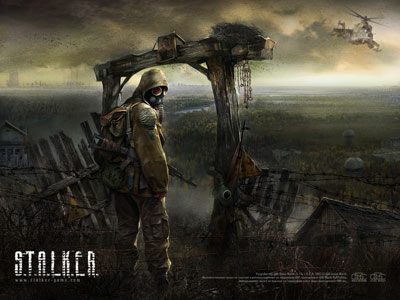
A fun game in its own right, S.T.A.L.K.E.R.: Shadow of Chernobyl is also a really interesting commentary on the mythology of nuclear power. The second nuclear event creates great disaster in the form of anomalies but also creates great potential in the form of the artifacts, much as in real life. The characters in the game all treat radiation and the anomalies as supernatural events which can't be explained, a perspective I also saw reflected in the interview shown in class with one of the "bio-robots", who described the rooftop of reactor four as the surface of an alien world. The big twist near the end brings in an additional level of interpretation. Out of respect for anyone interesting in playing the game (and I really encourage it!), I'll write the next few sentences in white to avoid any spoilers. Highlight at your own risk. As it turns out, the second disaster was, like the first one, of human origins. After Chernobyl, Soviet scientists took advantage of the desolation to establish a science facility underneath the reactor dedicated to exploring the science of mind control. They created a device that allowed seven scientists to link their minds into a collective consciousness and interact with the global Noosphere (link), but they lost control and created the Zone as a result. It's a wonderful commentary on the man-made nature of nuclear power, which seems unnatural and uncontrollable but has its very roots in human scientific exploration.

Just Curious, Robert, do you know... the game "half-life" ... is this also based on the idea of radiation exposure? ^__^ Carolyn
ReplyDelete